Red-osier Dogwood
Other Names: red osier dogwood, red twig dogwood, kinnikinik
Other Botanical Names: Cornus sericea
Family: Cornaceae
Native to: Eastern North America, Interior North America, Western North America
Hardy to zone: 2
Eco benefits: attracts pollinators, erosion control, attracts birds
Natural habitat: waters edge, floodplains, forest edge
Shapes: round, multi-stemmed, clump
Height: 7-9ft
Growth rate: medium
Unique attractions: fall colour, bark, flowers, fruit, winter interest
Common uses: landscaping, cityscape, naturalized plantings
Light: full sun, partial shade
Soil: moist and fertile, well drained, tolerates heavy clay, alkaline ph, wet
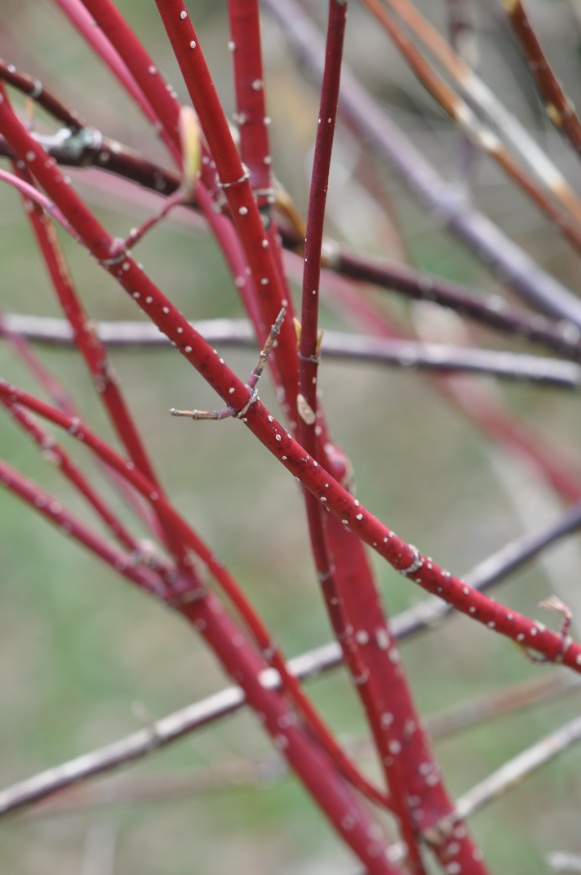
Red-osier dogwood, Cornus stolonifera (formerly C. sericea) is a medium to large shrub native to North America. Its the most widespread species of the native dogwoods. The shrub provides four seasons of interest with vibrant dark red winter twigs, flower clusters and white berries. The shape is round and multistemmed; habit is vigorous, forming thickets from stolons, hence the name 'stolonifera'.
Flat clusters of small Yellowish white flowers are borne late May to early June, attracting bees and other insects for pollination. Flowering is best in full sun but the shrub tolerates some shade. In late summer, clusters of blueish white fruit appear and attract many bird species.
As with other dogwoods, oval leaves have prominent veins that follow the leaf outline (arcuate). The colour is green, turning reddish purple in the fall. Twigs are smooth with a unique and attractive red colour; showy in winter. Its dense branching serves as wildlife habitat and prominent browse for deer and rabbits. The name osier is French for 'willow shoot' due to its smooth colorful twigs.
The Shallow, dense root system of red-osier dogwood stabilizes riverbanks and can be planted on farm edges to reduce erosion and block snow. The shrub has been used by natives as a tobacco substitute; twigs have also been used in weaving and basketry.
References
Coublar, S., Canadian Wildlife Federation. Retrieved from https://cwf-fcf.org/en/resources/encyclopedias/flora/dogwood.html
Government of Canada. (2015). Red-osier dogwood. Retrieved from https://www.agr.gc.ca/eng/agriculture-and-the-environment/agricultural-practices/agroforestry/shelterbelt-planning-and-establishment/selecting-trees-and-shrubs-species/red-osier-dogwood/?id=1345845710463
The Morton Arboretum. (n.d.). Red-osier dogwood. Retrieved from https://www.mortonarb.org/trees-plants/tree-plant-descriptions/red-osier-dogwood
U.S. Forest Service. (n.d.). Red Osier Dogwood. Retrieved from https://www.fs.fed.us/wildflowers/plant-of-the-week/cornus_sericea.shtml