Green Alder
Other Names: American green alder, mountain alder
Other Botanical Names: Alnus crispa
Family: Betulaceae
Native to: Eastern North America, Interior North America, Western North America
Eco benefits: erosion control, attracts birds, medicinal, windbreak, improves soil
Natural habitat: understory, barren or disturbed ground, mountains, seaside, waters edge, hillsides & uplands, rocky slopes, dunes
Shapes: round, multi-stemmed, clump
Height: 3-13ft
Growth rate: slow
Unique attractions: fruit
Common uses: naturalized plantings
Light: full sun, partial shade
Soil: moist and fertile, tolerates heavy clay, ph adaptable, wet, sandy
Reproduction type: monoacious
Green alder is a large spreading shrub, often forming thickets and occurring across North America; widely distributed from Alaska to Greenland. It is a close relative to the stika alder (Alnus viridus ssp. sinuata) and together these species span the Northern Hemisphere. Green alder is a short-lived 'nurse tree' or pioneer species following glacial retreat, landslides, or man made disturbances. Interestingly, it has a symbiotic relationship with microorganisms that can fix nitrogen from the air.
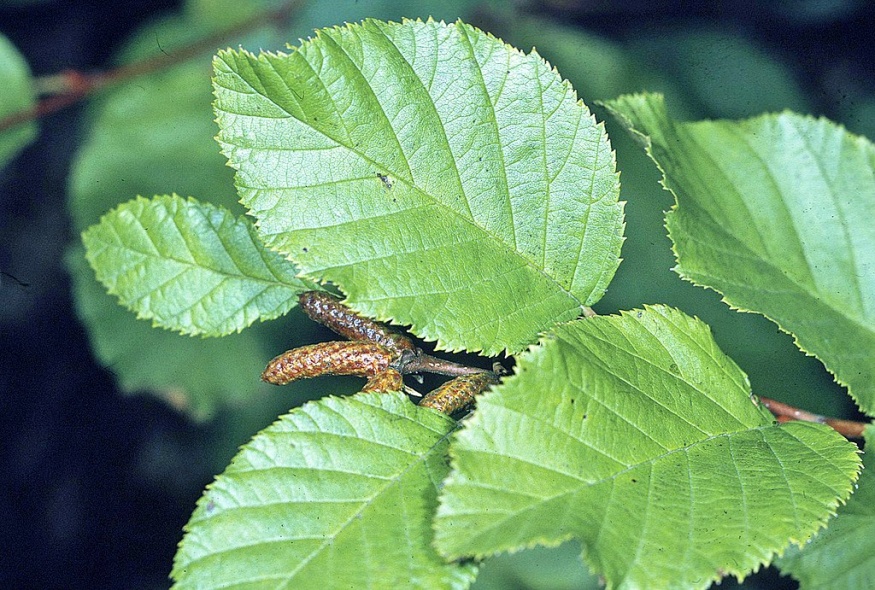
Leaves are shinny, yellowish green, ovate or broadly elliptic; finely toothed and possibly undulated. Smooth, dark reddish brown twigs are covered with light lenticels. Male and female flowers occur on the same tree and appear from April to May. Like other alders, the fruit is cone-like, starting yellow then turning brown.
The bark has been use medicinally by natives as an astringent, or for tanning leather and dying textiles. Green alder is ecologically valuable as a soil stabilizer for streambanks, as a windbreak, and to improve soil quality in nutrient poor sites.
References
Fire Effects Information System (FEIS). (n.d.). Alnus viridis subsp. crispa Retrieved from https://www.fs.fed.us/database/feis/plants/shrub/alnvirc/all.html
Lady Bird Johnson Wildflower Center. (2016). Alnus viridis. Retrieved from https://www.wildflower.org/plants/result.php?id_plant=alvi5
Oregon State University. (n.d.). Alnus viridis subsp. crispa. Retrieved from https://landscapeplants.oregonstate.edu/plants/alnus-viridis-subsp-crispa#:~:text=crispa,-Alnus%20viridis%20subsp&text=Broadleaf%2C%20deciduous%2C%20large%20spreading%20shrub,lenticels%20(appear%20as%20dots).
Plants For A Future. (2018). Alnus viridis crispa - (Aiton.)Turrill. Retrieved from https://pfaf.org/user/Plant.aspx?LatinName=Alnus+viridis+crispaLatinName=Salix+eriocephala
Tree Canada. (n.d.). Green alder (Alnus viridis ssp. crispa). Retrieved from https://treecanada.ca/resources/trees-of-canada/green-alder-alnus-viridis-ssp-crispa/
United States Department of Agriculture. (n.d.). Stika Alder. Retrieved from https://plants.usda.gov/plantguide/pdf/pg_alvis.pdf